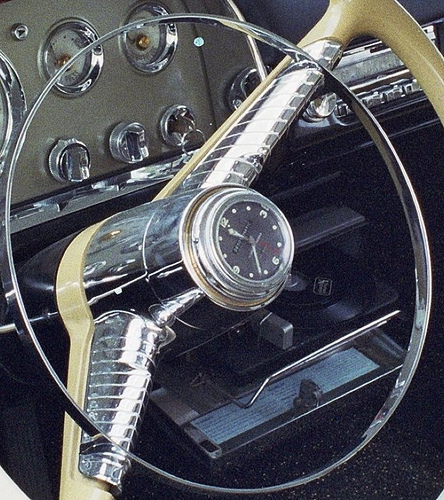
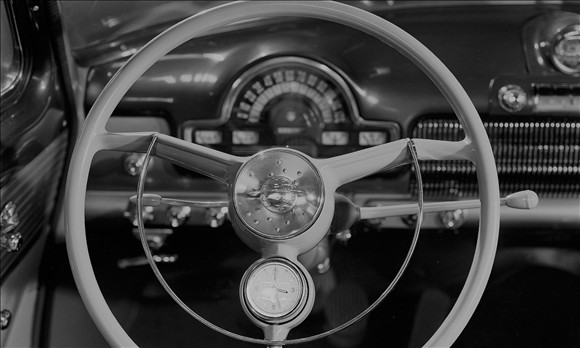
When it comes to the unusual accessories offered on Chrysler product cars in the 1950s the
steering wheel watch has to rate very high on the oddity scale! Not only was it quite costly,
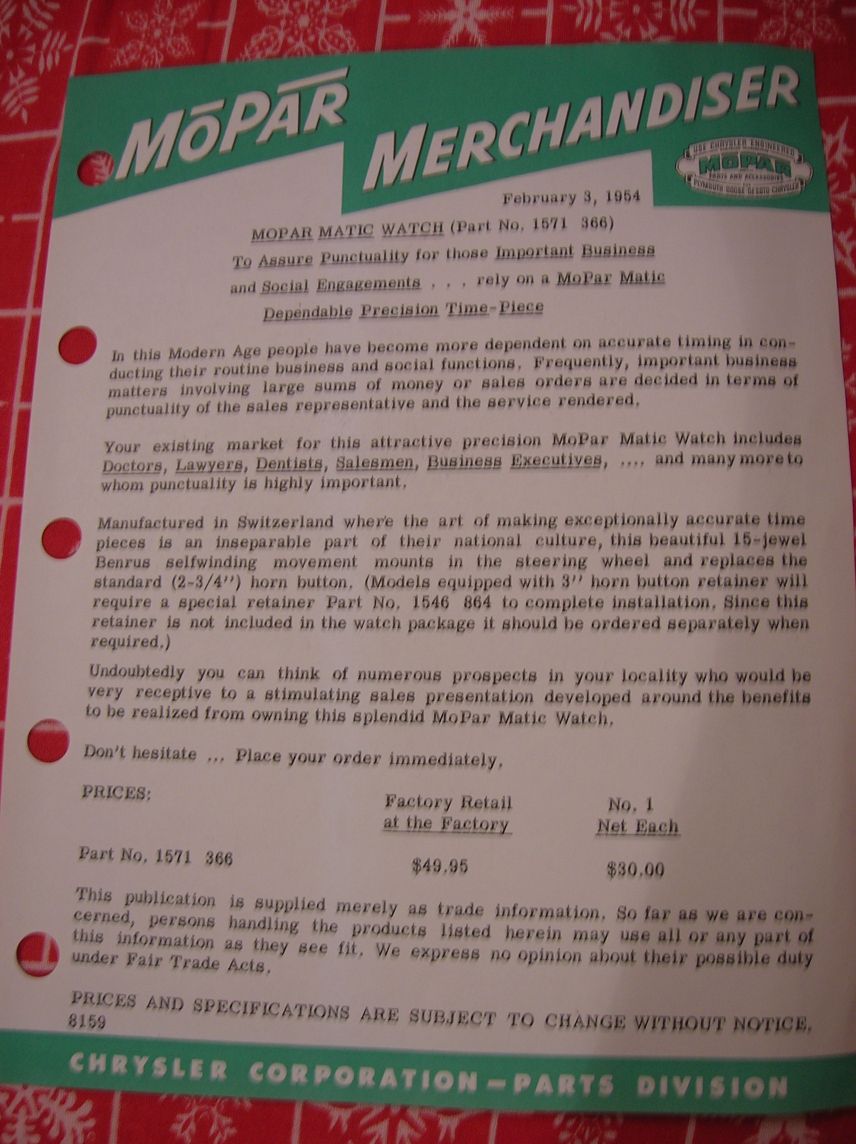
$49.95 compared to approx.$12-15 for a dash mount clock. But it was also impractical!
One reason is since the unit was not driven by electric power the face was not illuminated at
night. Sure the hands and primary numbers were treated with that early glow in the dark stuff
but it did not work that well. Another reason is that when you were taking a corner telling
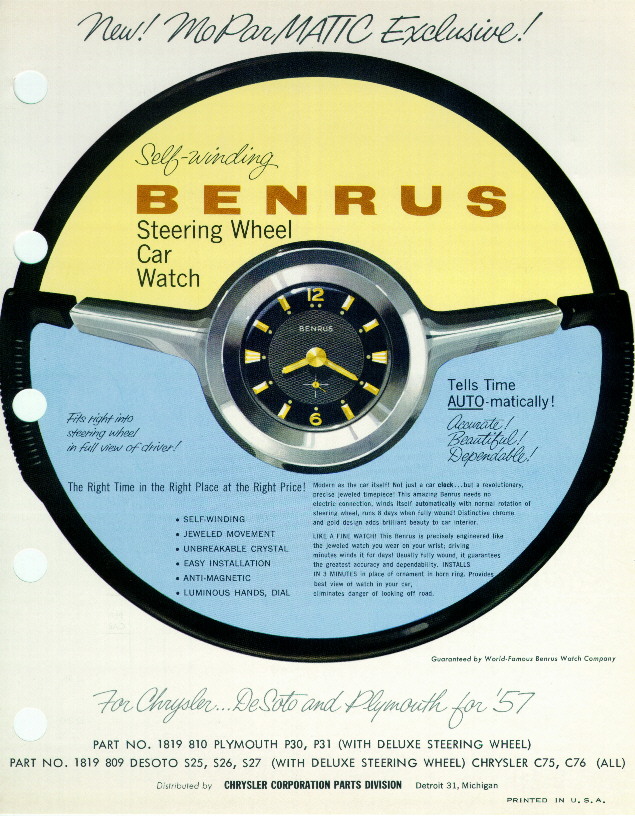
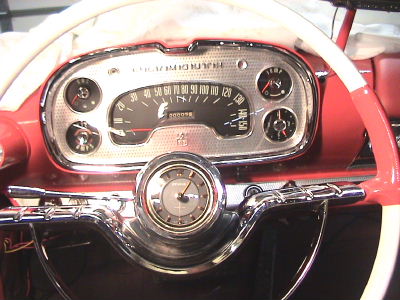
the time could be a challenge. One of the pitches they used to sell the clock is that its
Swiss movement was much more accurate than that of the dash clock. And the
central mounting locationmade it more visible. I would have to say that this is true. But is it really worth more
than twice the price of the dash clock?
The next question you might ask is how did the thing work since it was not electrical? If you
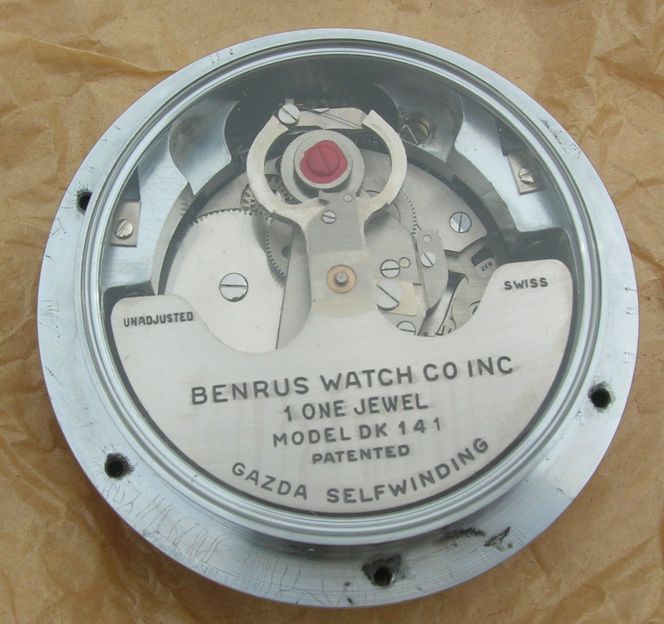
remember the early wristwatches that were self-winding this is the same technology that
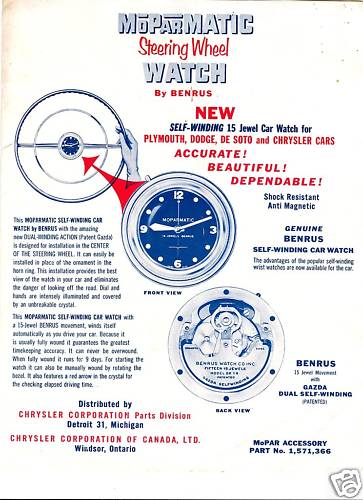
was used on the steering wheel watches. As you drove the car the turning action of the wheel
via a counterweighted pendulum connected through a gear mechanism would wind the main spring of the 8-day Gaza movement. On the early version the face could also be rotated to wind the main spring.
There are two basic versions of steering wheel clock that were offered by Chrysler corp.
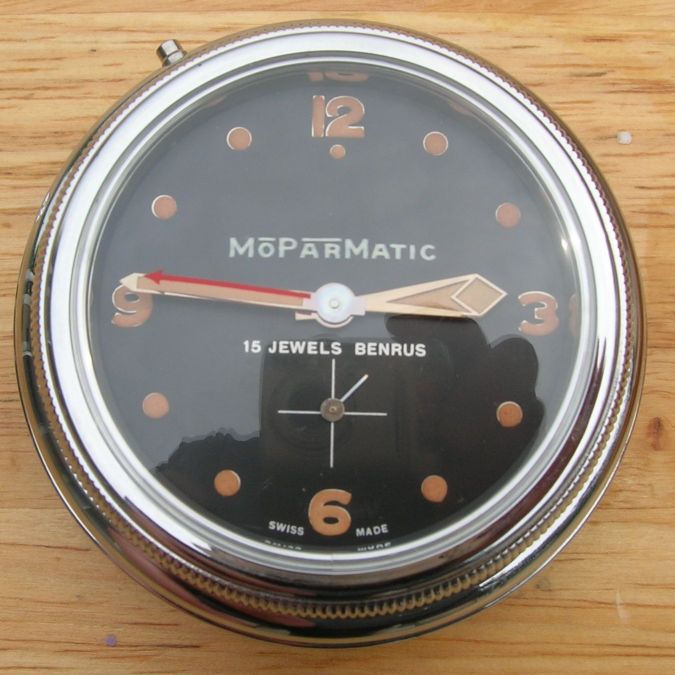
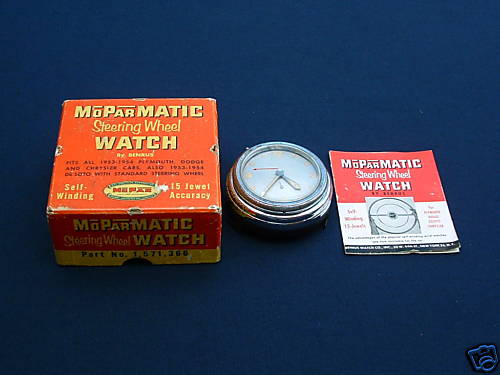
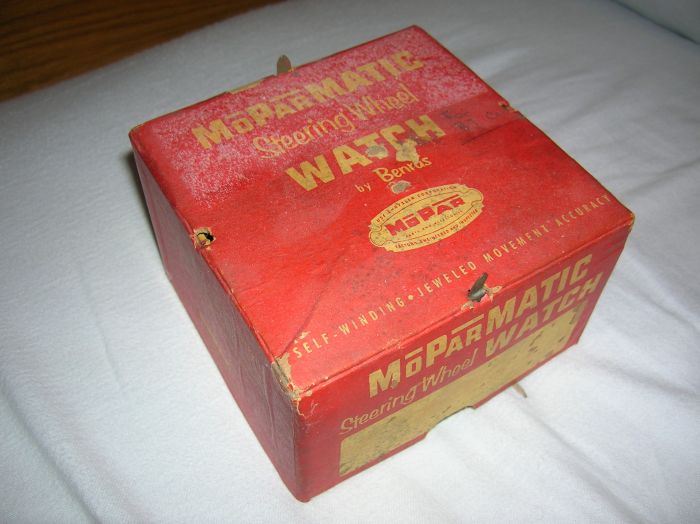
(MoPar) the first was introduced on Feb. 3 1954 was the Moparmatic and would fit the 53 models
also. These could be factory or dealer installed and were very easy to install
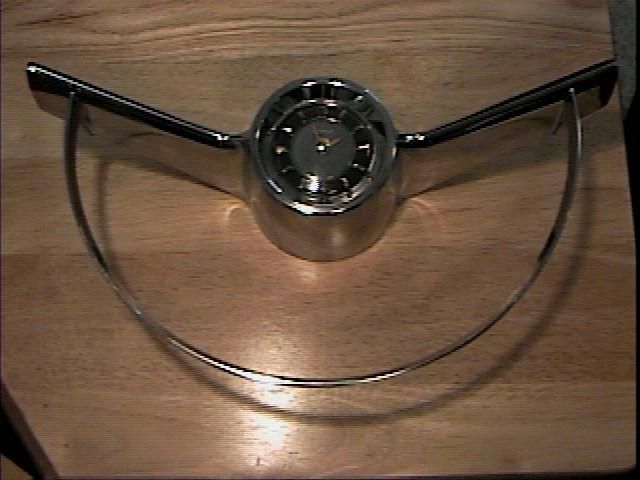
simply grasp the horn ring center and turn counter clockwise 1/4 turn and remove the original
horn ring center and install the watch with the opposite action. There were 5 different names
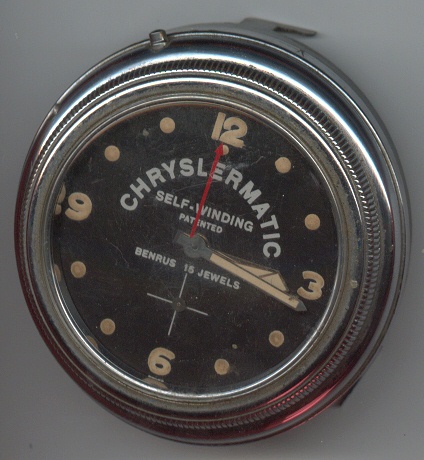
applied to the first version Moparmatic, Chryslermatic, Desotomatic, Dodgematic and
Plymouthmatic. I would have to say that the one for the Dodge is the rarest version since
Dodge changed its horn ring design in 1955 and eliminated the round removable center medallion
this option was only available in 1953-54 for the dodge line. This makes the Dodgematic the
rarest of all of the steering wheel clocks, I have never seen one. Next would be the Plymouthmatic since $50.00 was a pretty steep price for a Plymouth buyer to pay relative to the cost of the car. The Chrysler
and Desoto versions probably are about the same with the Moparmatic being the most common. Of
course "common" is not a relative term when it comes to these as they do not show up very often.
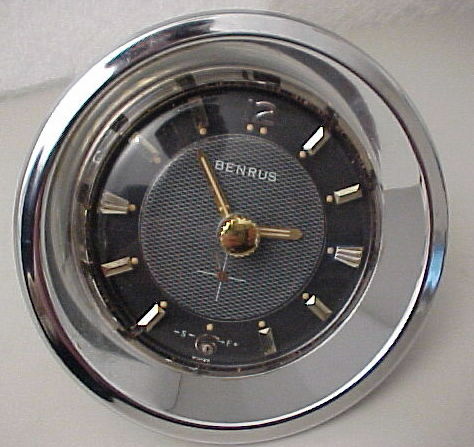
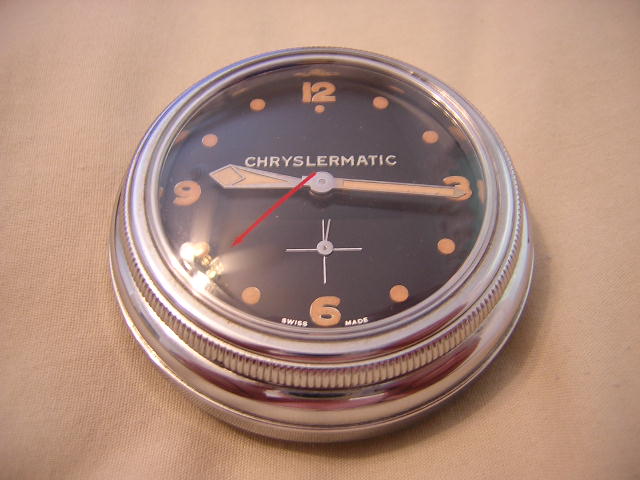
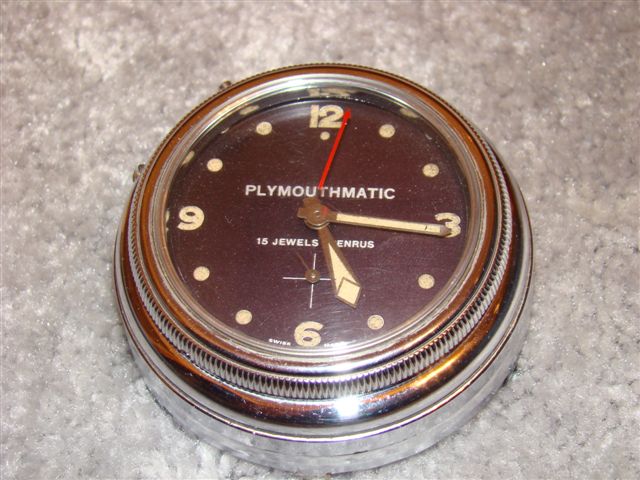
The first style offered by Benrus was a 15-jewel DK14 movement and the crystal could be turned to wind
the watch and there was also a red pointer on the face of the crystal that could be used to
monitor elapsed driving time. A small button at the eleven o'clock position was used to set
the time. By depressing this button and rotating the face the time could be set.
The First Available was the Moparmatic #1571-366 for use in any Chrysler Corporation
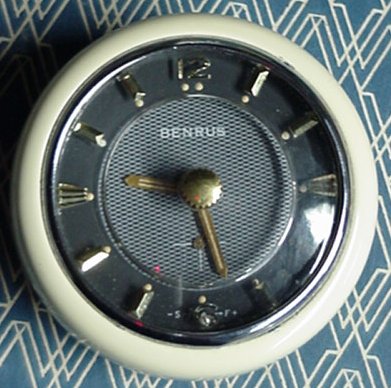
passenger car. Then came the Chryslermatic #1689-112, Desotomatic # 1689-057, and Plymouthmatic part # XXX-XXXX there is also a slight variation between the early and late first series Chryslermatic clocks the early
editions name was in an arch not straight like the later version.
Because of the different sizes of holes in the center of the horn rings there were adapters available to
make them fit. The 2 3/4" was the standard size and the 3" holes required retainer #1546-864 if you go to the first generation mountings page I will try to show the differences. This first generation clocks with the 15 jewel DK-14 movements were used until 1956 when the next generation 7 jewel FA-14 movement was introduced for the 1957 model year series.
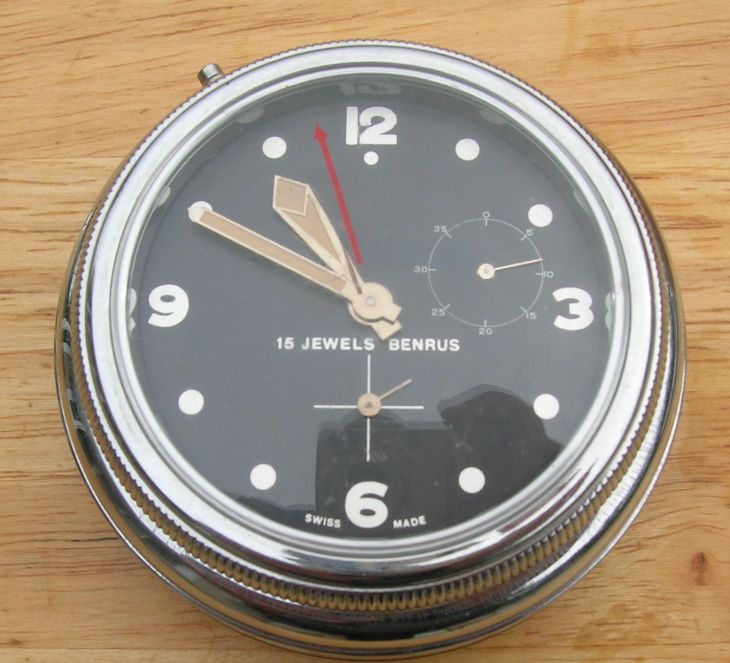
By 1957 the design was changed gone was the rotating face crystal with red pointer the clock
was set by depressing the button in the middle of the hands and turning. The fine adjusts
screw came through the crystal in the center of the number 6. Also gone was any series
identification with no reference to Chrysler Corporation, MoPar or any of the model lines.
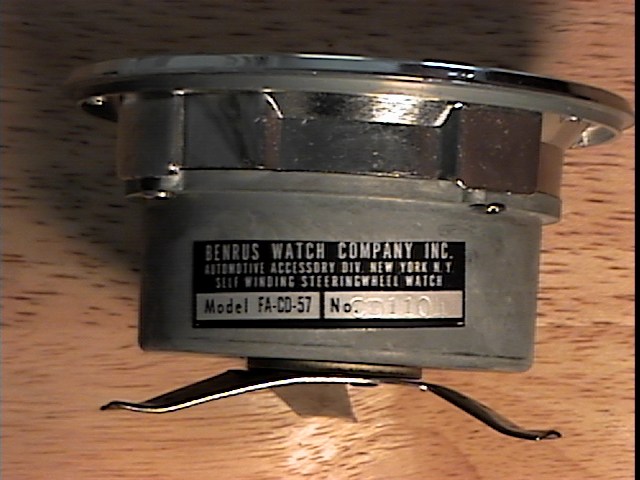
These could be purchased from Chrysler Corporation or directly from Benrus, the only difference
was the small tag on the side of the units from Benrus. While still an 8-day clock the new unit
now only carried 7 jewels in the FA14 movement. The 1957-58 Chrylser and Desoto used (MoPar #1819-809)
(Benrus part # FA-CD-57) and Plymouth 1957-58 used (MoPar #1819-810). The cost still
remained at the $50.00 level so sales were not brisk. There still seems to be a good supply of
the second generation clock movements (I would imagine that Benrus produced many more than were
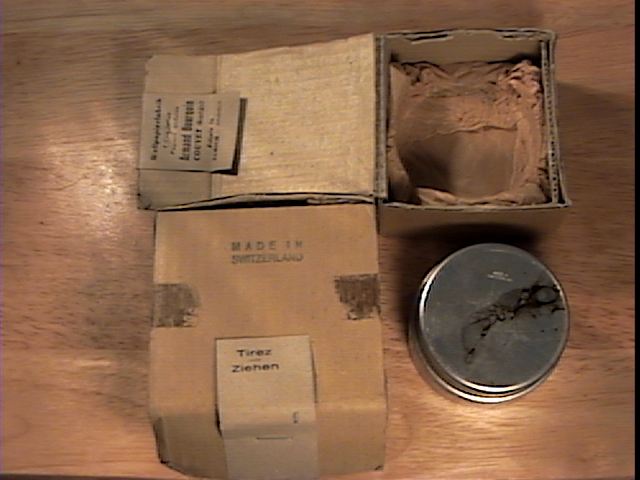
needed) but the mounting retainers are very difficult to find. I often see people listing FA14 movements in the original shipping tin on Ebay and state that it just goes in your horn button, this is not correct. While Chrysler corp. was not the first to use the self-winding steering wheel clock it was the most successful with a
six year run. I make and sell the 1957 1958 Plymouth mounting bezel so I do buy the movements if you have one for sale.
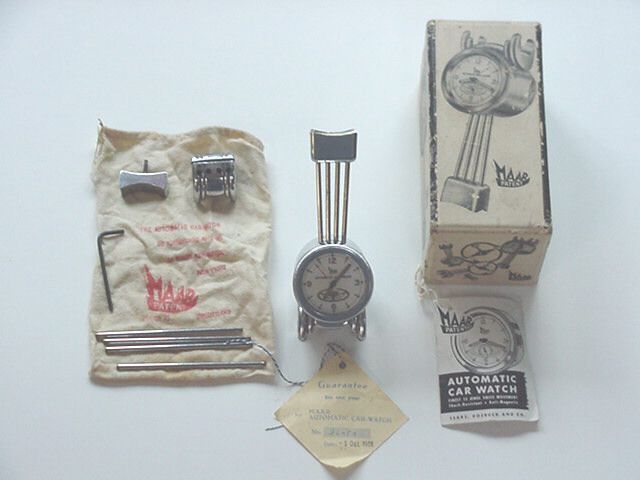
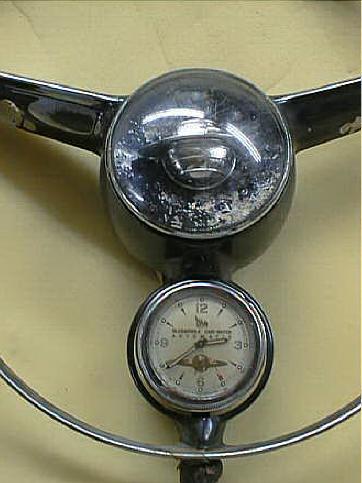
Oldsmobile had offered a Swiss made MAAR unit that mounted below center on a specially designed
steering wheel and a special horn ring. This was available from 1951-52 and operated much the same way as the early Benrus, with one major difference the winding mechanism on the Maar unit worked with forward
and back movements also (acceleration and braking) along with rotation of the steering wheel.
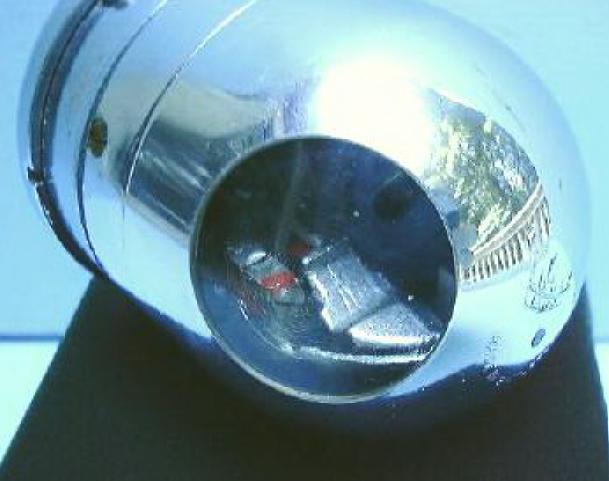
The winding mechanisms also had small plastic windows were the operation of the unit could be
viewed. This caused the clock to be fairly deep and a special turn signal arm was needed to
clear the back of the unit when steering. Part of the steering wheel package was a dash mounted compass that went intothe hole were the dash clock was. I have more information available on the Oldsmobile Maar overflow page
Other MAAR Applications
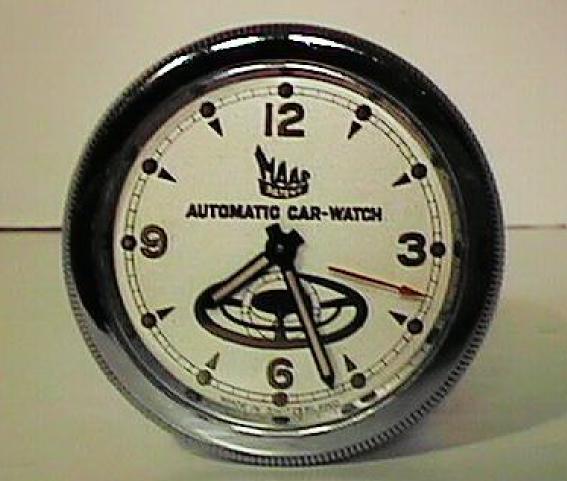
The MAAR Company also made the steering wheel watch without the Oldsmobile logo! it just said
"automatic car watch" this plain version was available with a spoke mounted holder was designed to clamp onto the steering wheel and look like another spoke of a banjo
steering wheel or just clamp onto any steering wheel. For additional information and images can be found on the Plain Maar overflow page
Chevrolet MAAR
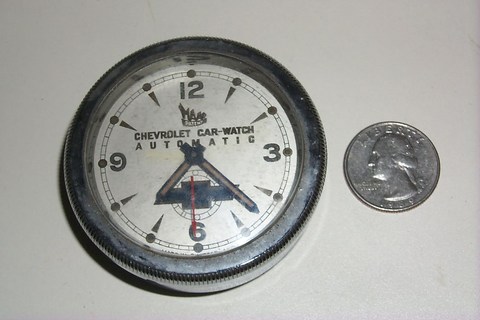
MAAR even made one with the Chevrolet Bowtie on it, the "Chevrolet car watch" I am not sure how many they made but I have seen three of them so far. they would use the same gyroscopic winding mechanism as the Oldsmobile version. I have never seen one mounted on a steering wheel so I do not know if there was a special steering wheel but I suspect it was spoke mounted or clamp mounted like the plain Maar. For additional information go to the Chevy Maar overflow page
Volkswagen Benrus
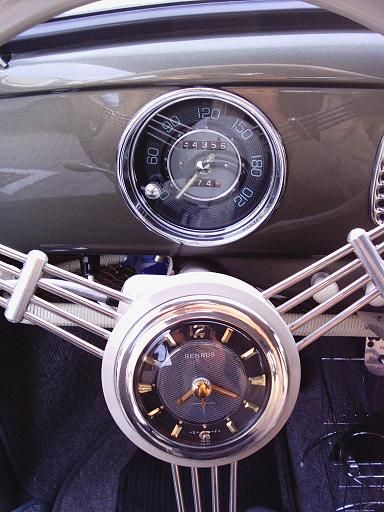
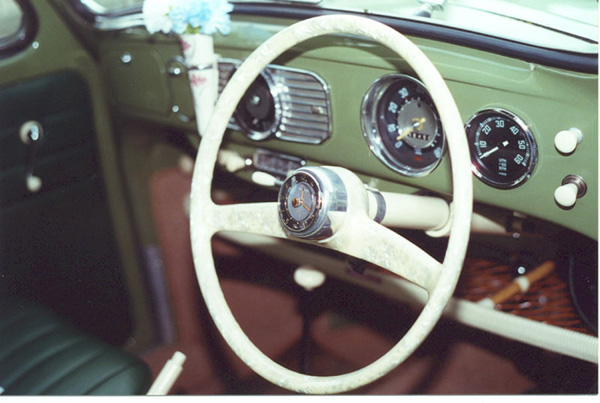
Thanks to KOBUS BELGIUM I now have pictures of a Volkswagen version of the steering wheel
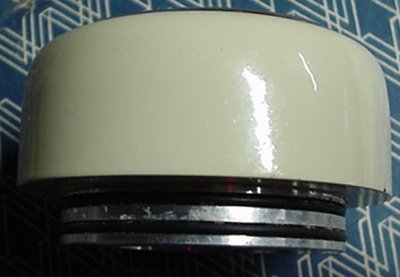
clock. It uses the second-generation Benrus movement mounting in a special retainer to hold the
mechanism securely in the center of the horn ring with o-rings while still allowing the
pendulum to turn freely. I have been told that Volkswagon never offered these from the factory and may have been an aftermarket offering only? For additional images and information go to the VW overflow page I have been told that Benrus also offered the clocks for many other manufacturers, as I find more info I will add it here I remember seeing an ad from the 50s that offered them for multiple applications so I will assume that Benrus made mountings for many cars? If anyone has additional information please send it to me.
They always say a picture is worth a thousand words? Well how much is a video worth? These should help show what steering wheel clocks were all about.
If you have additional information, images or literature you would like to share I will add it to the webpage during a future update. Also if you have any of these clocks for sale I am a buyer or may be able to help you find a buyer.
Use of images or information on these pages is forbiden without permission. I will be glad to assist magazine editors etc. in putting together an article about these clocks and only ask that the website be mentioned in the article and I get a copy of the final publication.
Welcome to my mis-spelled word file!
These are common and sometimes uncommon ways to mis-spell the primary words on this site!
I provide this as a service to the phonically challenged because they are people too! Or maybe
they have a typing handicap like myself. Crysler, Chrystler, Christler, Desota, De Sota, Desotoe,
Desoda, Dasoda, fibre, fibreglass hiway, hifi, krysler, Mo Par, Peddel, Peddal, Peddle, Plymoth
, Plimoth, Plimouth,